

In New York, a judgment lien on real property arises when the money judgment is docketed with the county clerk in the county where the property is located (not merely upon entry).
If you have been sued and either failed to formally respond (resulting in a default judgment) or were defeated in court (losing on the merits of the case), you become the judgment debtor. A docketed judgment lien attaches to the judgment debtor’s real-property interests in that county; enforcement is limited by exemptions (e.g., the homestead exemption), and the lien reaches only equity above the exempt amount.
A lien, generally, is defined as a legal right or interest that a creditor has in another's property, lasting usually until a debt or duty that it secures is satisfied.
A lien is imposed against a judgment debtor's nonexempt property. For a list of exempt personal property, see this blog. For exempt homestead property, see this blog.
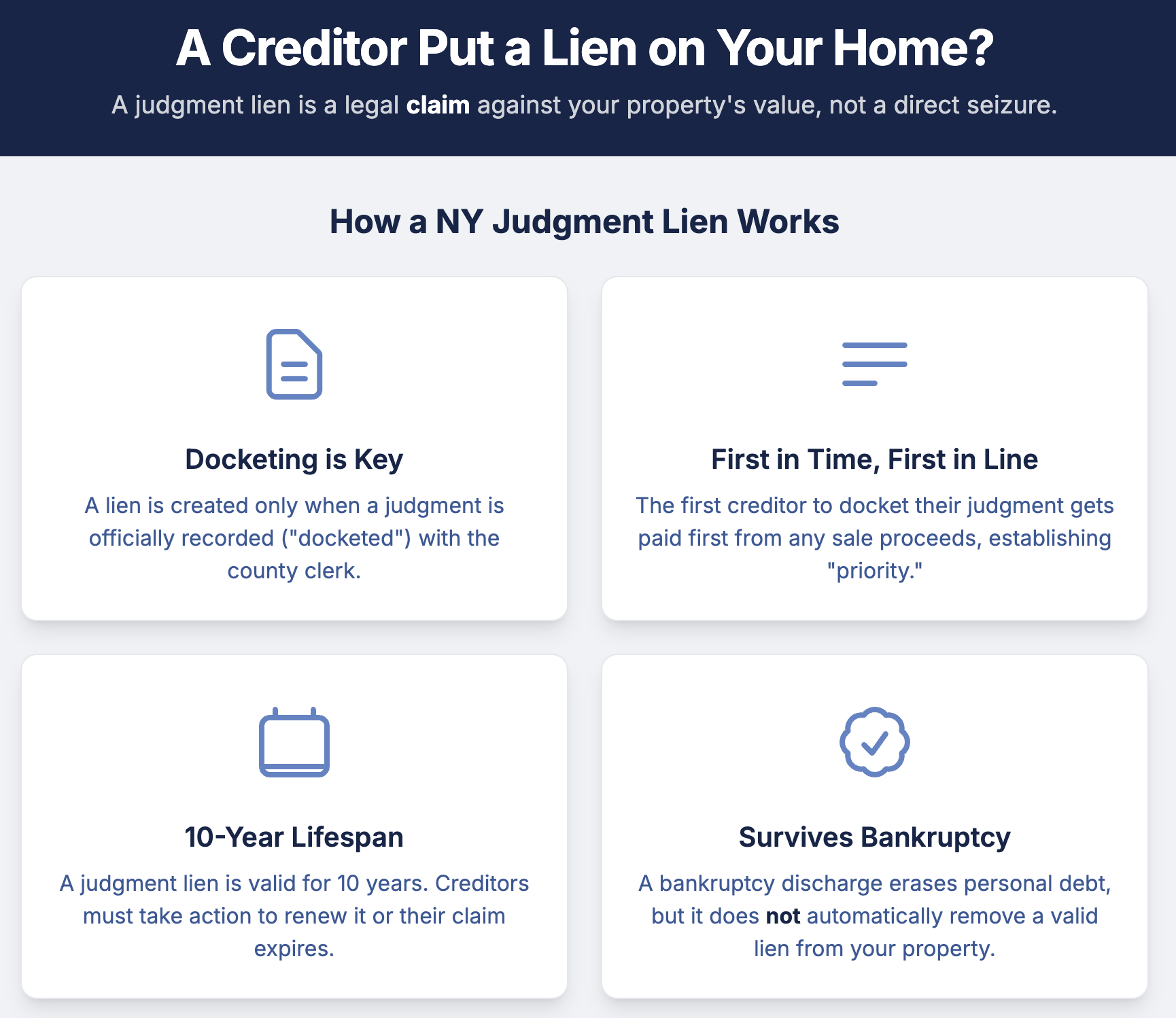
How NY Judgment Liens Work: 13 Must-Know Points
- Docketing a judgment is procedurally simple, but accuracy is critical. Errors in names, venue, or timing can jeopardize priority and enforceability. Example: A creditor can easily file a lien against a debtor's property with minimal legal fees, rather than pursuing more complex enforcement methods.
- A judgment lien does not itself give possession; separate proceedings (such as execution or receivership) are required to control or sell the property.[1] Explanation: The lien acts as a claim against the property's value, not a direct takeover of the property itself.
- A creditor is often paid on sale/refinance, but should monitor the 10-year lien period and timely renew/extend to preserve priority. Example: If a debtor decides to refinance their mortgaged home, the lien must be satisfied before the refinancing can proceed, ensuring payment to the creditor.
- Material name errors can defeat notice and priority against third parties, even though the judgment itself remains valid. Always confirm how the judgment was indexed through a title search. Do a title search to verify proper recordation) to protect a good-faith purchaser of the land subjected to the improperly indexed judgment. Example: A judgment filed against "Jon Smith" won't affect property owned by "John Smith," protecting an innocent buyer who purchases property from "John Smith."
- ITo enforce a sister-state judgment in New York, file an authenticated copy under CPLR 5402; once filed, it is treated as a New York judgment. File an authenticated sister-state judgment with the county clerk under CPLR 5402; once filed, it has the same effect as a NY Supreme Court judgment. Explanation: This means converting the out-of-state judgment into a local one, legally recognizing it in the state where enforcement is sought.
- A judgment lien on real property establishes priority over later claimants. Example: If a property is subject to multiple debts, the first recorded judgment lien takes precedence in being paid off over later ones.
- A judgment lien attaches to the debtor’s real property in the county where the judgment is docketed. Explanation: This may include land, buildings, and certain fixtures on the property in that county.
- A docketed judgment attaches to the debtor’s later-acquired real property in that county, subject to prior liens, mortgages, and statutory exemptions. Example: If the debtor buys new property in the same county after the lien is issued, the lien automatically applies to this new property.
- The lien follows the property, but its priority is determined by statute and recording rules, and may be subordinate to earlier or protected interests. Explanation: The lien remains with the property even if it changes hands, ensuring the creditor's claim is prioritized for any new interests in the property.
- Bankruptcy usually does not automatically remove liens, but judicial liens may be avoided if they impair an exemption under § 522(f), even if recorded shortly before filing. A debtor can move under 11 U.S.C. § 522(f) to avoid a judicial lien to the extent it impairs an exemption; the 90-day preference rule (§ 547) is a different concept. Example: A debtor who files for bankruptcy cannot eliminate a lien that was perfected on their property three months before the bankruptcy filing.
- The impact of a judgment lien varies widely depending on collateral, credit needs, and other pending enforcement actions. Explanation: Because the debtor's assets aren't immediately seized, they can continue business operations, which lessens the financial strain that might otherwise lead to bankruptcy.
- A properly filed notice of levy does not bar transfers, but makes later transfers ineffective against the creditor while the levy remains in force. Example: This legal notice effectively prevents the sale or transfer of the property until the debt covered by the lien is paid off.
- Use CPLR § 5226 to require the debtor to make installment payments; Future rental streams may be reachable under CPLR § 5227, but courts evaluate lease terms, existing assignments, and competing lien priorities. Example: If the debtor is a landlord, the creditor can obtain a court order to divert future rental income from tenants to satisfy the debt.
- See here how a docketed judgment becomes a judgment lien against real property.
Keep in mind, friends, that this post, along with all others, involves New York laws.

[1] Black's Law Dictionary, 1053 (10th ed 2014).