

In New York practice, "entry" and "docketing" are related but distinct procedural acts. Understanding the distinction helps determine when a judgment becomes effective as a judgment and when it creates a lien on real property.
Entry versus Docketing of a New York Judgment
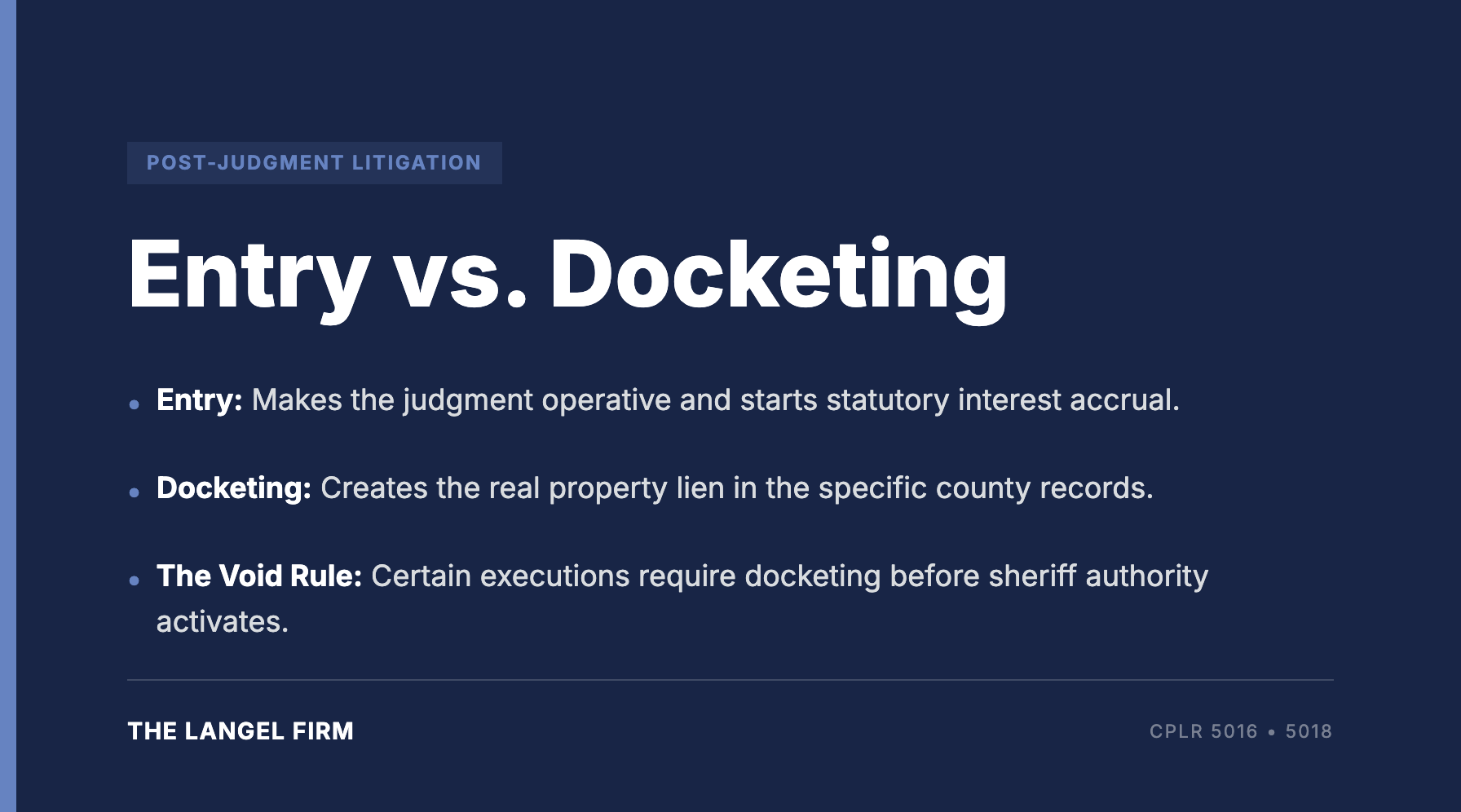
Entry is the act that makes the judgment operative as a judgment. Under CPLR 5016(a), a judgment is entered when, after it has been signed by the clerk, it is filed by the clerk. Entry is the procedural act that makes a judgment effective for purposes of enforcement and appeal. Once entered, a money judgment bears interest from the date of entry under CPLR 5003.
Docketing is the clerk’s separate ministerial act of recording the judgment in the docket. Under CPLR 5018(a), the clerk dockets a money judgment immediately after filing the judgment-roll, and a transcript may be used to docket the judgment in another county or from another court. Docketing matters because it gives the judgment public-record effect in the county docket and is tied to lien consequences on real property in the county where the judgment is docketed.
In short: Entry creates the judgment as an enforceable money judgment; docketing records it in the appropriate docket and is what matters for county-by-county lien consequences and certain enforcement mechanics.
The Interest Framework: When Interest Begins
New York law recognizes different stages of interest governed by specific statutes. CPLR 5004 sets the applicable rate, but the categories are defined as follows:
Pre-decision Interest (CPLR 5001): Governs prejudgment interest in specified actions, including many contract and property-based claims, from the accrual of the claim to the verdict or decision.
Verdict-to-Judgment Interest (CPLR 5002): Governs interest from the date the verdict was rendered or the report or decision was made to the date of entry of final judgment.
Post-judgment Interest (CPLR 5003): Governs interest upon a money judgment from the date of its entry.
The 2% Consumer-Debt Rate
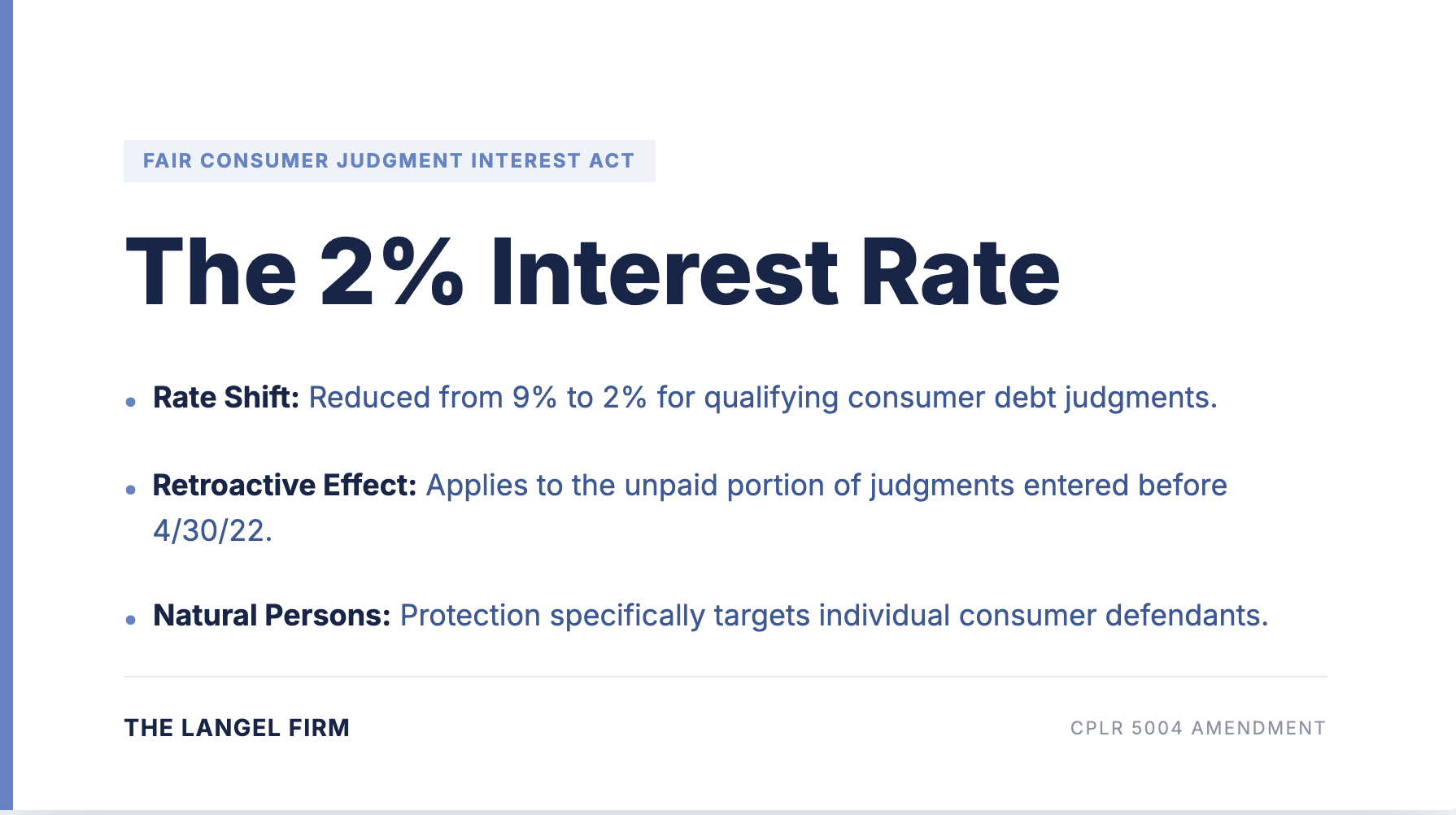
The Fair Consumer Judgment Interest Act (FCJIA) amended CPLR 5004 to provide that the annual rate of interest in an action arising out of a consumer debt where a natural person is a defendant is 2% per annum, rather than 9%, in the circumstances specified by the statute.
This 2% rate applies to consumer judgments entered on or after April 30, 2022. It also applies prospectively to post-judgment interest under CPLR 5003 on any portion of certain earlier consumer judgments that remained unpaid as of that effective date. "Consumer debt" generally refers to obligations incurred primarily for personal, family, or household purposes, such as credit card debt or medical bills.
Equitable Relief Under CPLR 5240
In limited circumstances, courts may use CPLR 5240 to regulate enforcement where a creditor’s conduct would create unreasonable prejudice. The statute allows a court to "deny, limit, condition, regulate, extend or modify the use of any enforcement procedure." While statutory interest is generally mandatory, courts have occasionally used this "safety valve" to regulate enforcement where a creditor's unexplained and substantial delay causes unreasonable prejudice to the debtor.
A Note on the Judgment-Roll
CPLR 5017 provides for the preparation and filing of a "judgment-roll," and CPLR 5018 refers to docketing immediately after filing that roll. However, in modern day-to-day practice—especially with electronic filing—lawyers and clerks focus less on the judgment-roll as a practical center and more on whether the judgment has been signed, filed, entered, and docketed in the proper place (including by transcript where necessary).
Expanding Enforcement: Transcripts and Remarks
Judiciary Law 255-c authorizes standardized forms for transcripts and certificates of judgment. These forms often include a "REMARKS" section, which is the official ledger for any change in the status of the judgment since its original entry, including assignments, reversals, modifications, or discharges. For debtors, a Certificate of Disposition is the "operational" document required to prove to enforcement officers or title companies that a judgment has been vacated or satisfied.
Key Differences: Entry vs. Docketing
| Aspect | Entry (CPLR 5016) | Docketing (CPLR 5018) |
What it is | Filing of the signed judgment by the clerk | Recording of the judgment in the clerk’s docket |
Main effect | Makes the judgment operative; starts post-judgment interest | Creates county-specific docket consequences; supports liens |
Interest consequence | Money judgment bears interest from entry (CPLR 5003) | Orders docketed as judgments bear interest from docketing |
Geography | Occurs in the rendering court | May also occur in other counties by transcript |
Lien Effect | Does not create a real property lien | Creates a lien on real property in that specific county |
Links to Law and Cases
New York Statutes
CPLR § 3215 – Default Judgments
https://www.nysenate.gov/legislation/laws/CVP/3215CPLR § 5001 – Interest to Verdict, Report, or Decision
https://www.nysenate.gov/legislation/laws/CVP/5001CPLR § 5002 – Interest from Verdict or Decision to Judgment
https://www.nysenate.gov/legislation/laws/CVP/5002CPLR § 5003 – Interest Upon Judgment
https://www.nysenate.gov/legislation/laws/CVP/5003CPLR § 5004 – Rate of Interest (including consumer debt interest rate)
https://www.nysenate.gov/legislation/laws/CVP/5004CPLR § 5016 – Entry of Judgment
https://www.nysenate.gov/legislation/laws/CVP/5016CPLR § 5017 – Judgment Roll
https://www.nysenate.gov/legislation/laws/CVP/5017CPLR § 5018 – Docketing of Judgment
https://www.nysenate.gov/legislation/laws/CVP/5018CPLR § 5203 – Judgment Lien on Real Property
https://www.nysenate.gov/legislation/laws/CVP/5203CPLR § 5240 – Court’s Power to Regulate Enforcement Procedures
https://www.nysenate.gov/legislation/laws/CVP/5240CPLR § 211(b) – Twenty-Year Presumption of Payment of Judgments
https://www.nysenate.gov/legislation/laws/CVP/211
Additional Related Statutes
Judiciary Law § 255-c – Standardized Transcript and Certificate of Judgment Forms
https://www.nysenate.gov/legislation/laws/JUD/255-C
Cases
Dunham v. Reilly, 110 N.Y. 366 (1888)
https://cite.case.law/ny/110/366/
Blogs:

Educational analysis only. Not individualized legal advice.