

Many people assume that once they leave New York, a New York judgment can no longer reach their paycheck. Others assume the opposite—that a New York creditor can garnish wages anywhere in the country simply by serving a large employer's New York office.
Neither assumption is entirely correct.
Whether an income execution against out-of-state wages is enforceable depends on the procedures required by CPLR § 5231, the authority of the enforcement officer, the employer's presence in New York, and the particular facts of the case.
How Does the New York Wage Garnishment Process Actually Work?
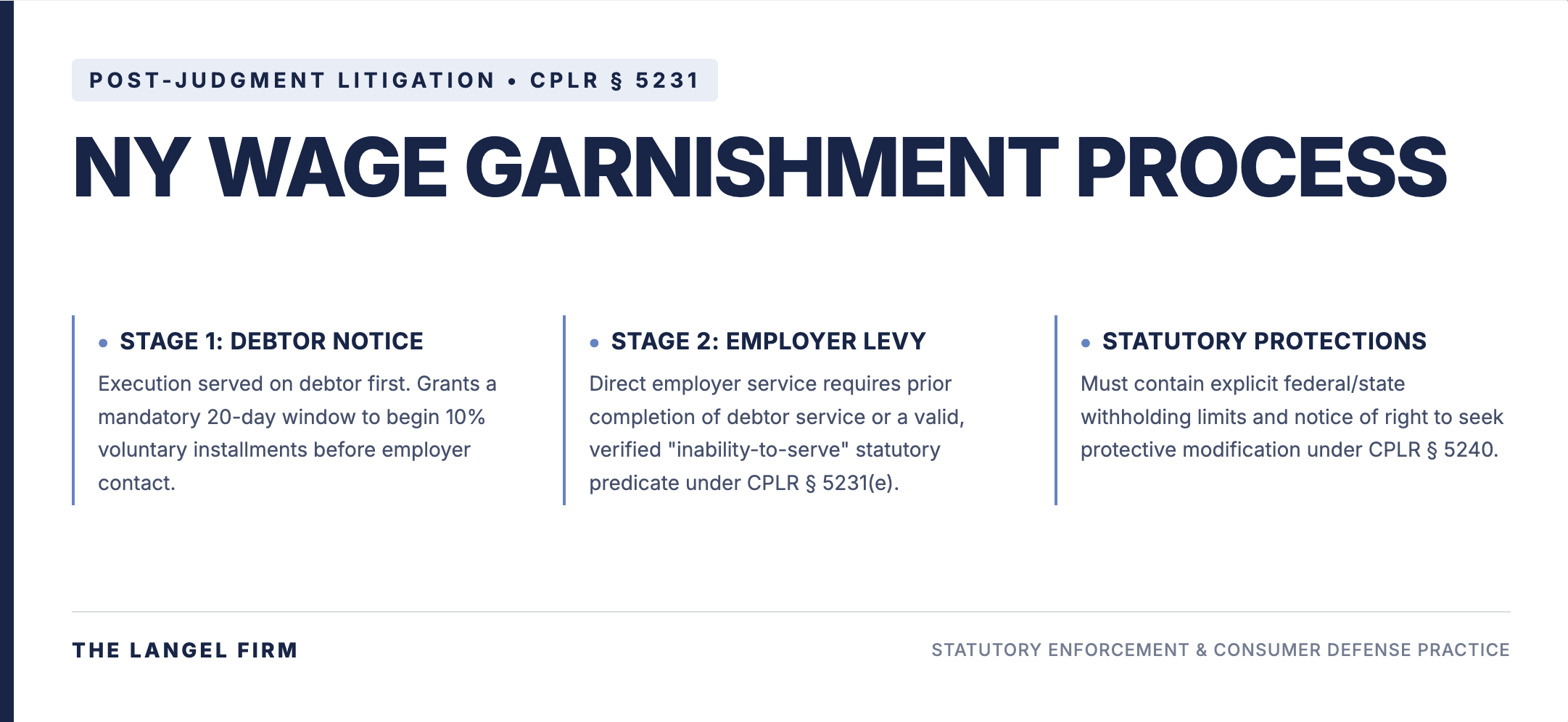
Under CPLR § 5231, an income execution is a multi-step statutory procedure. The statutory framework contains specific sequencing rules:
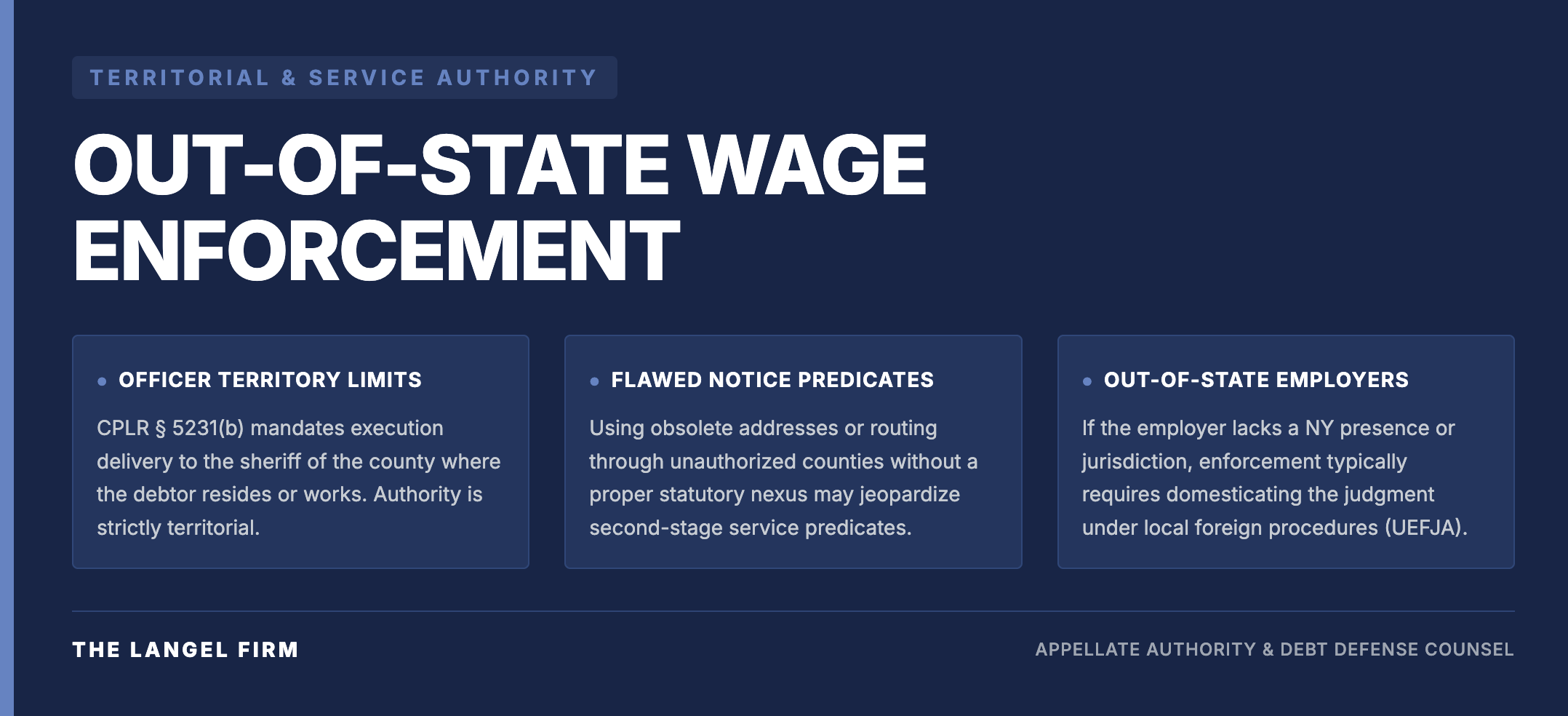
Delivery to the Proper Enforcement Officer: Under CPLR § 5231(b), the income execution is delivered to the sheriff of the county in which the judgment debtor resides. If the debtor is a non-resident of New York State, it is delivered to the sheriff of the county in which the debtor is employed. Depending on the court and territorial jurisdiction, an authorized enforcement officer may include a sheriff or, in appropriate local court matters such as New York City cases, a city marshal, subject to governing statutory and territorial limits.
First-Stage Service on the Debtor: Within 20 days after receiving the income execution, the enforcement officer must serve a copy on the judgment debtor under CPLR § 5231(d). Service must be made in the same manner as a summons, or by certified mail, return receipt requested, provided an additional copy is sent by regular mail. This stage affords the debtor a 20-day statutory window to begin paying installments voluntarily before the employer is contacted. The execution may direct installments of not more than 10% of gross income, subject to state and federal earnings limitations, disposable income protections, and statutory priority rules.
Mandatory Statutory Notice: The income execution must contain detailed statutory notices informing the debtor of applicable federal and state withholding limits and advising that the debtor may seek modification under CPLR § 5231(i) or protective relief under CPLR § 5240. Earlier federal litigation, including Follette v. Vitanza, 658 F. Supp. 492 (N.D.N.Y. 1987), addressed due process considerations regarding debtor notice, which have since been integrated into the explicit text of CPLR § 5231.
Second-Stage Levy on the Income Payer: Under CPLR § 5231(e), if the judgment debtor fails to pay installments for 20 days after first service, or if the sheriff is "unable to serve" the debtor within 20 days after delivery of the execution, the officer proceeds to second service upon the person or entity from whom the debtor receives income.
Practical Example: Bypassing the First Stage
Scenario: A creditor obtains a money judgment against Mark in New York. Mark earns $2,000 per week. Instead of delivering the execution for the required first-service procedure, the creditor arranges for Mark's employer to be served with an income execution demanding withholding without completing the debtor stage.
Outcome: Mark was deprived of the statutory opportunity to begin installment payments voluntarily before his employer was served. Because the first-service requirements under CPLR § 5231(d) were omitted without a valid statutory predicate, Mark has grounds to challenge the execution.
Can a Creditor Skip Giving Me Notice and Go Straight to My Employer?
Ordinarily, a creditor may not proceed directly to employer service without satisfying the first-service requirements. However, CPLR § 5231(e) expressly permits second service when the sheriff is unable to serve the debtor within the 20-day statutory period following delivery. Consequently, a debtor’s lack of actual receipt is not alone dispositive if a valid failure-to-serve predicate exists under the statute.
In the pre-2015 Civil Court decision Kaplan v. Supak & Sons Mfg. Co., 260 N.Y.S.2d 374, 46 Misc. 2d 574 (N.Y. City Ct. 1965), the court addressed an attempted income execution involving a judgment debtor who lived and worked in Massachusetts. Rather than attempting first service on the debtor, the creditor served the income execution directly on the New York sales office of the foreign corporate employer.
The court in Kaplan refused to enforce the execution, describing prior service on the judgment debtor as an indispensable prerequisite to levying on the employer under the statutory framework then in effect. Although Kaplan predates the 2015 amendments to CPLR § 5231, it reflects the statutory importance historically placed on preserving the debtor-stage notice before employer withholding.
What If the Warning Was Mailed to an Old Address in New York?
A recurring issue arises when an enforcement officer attempts first service at an outdated New York address after the debtor has relocated out of state.
Because CPLR § 5231(e) authorizes second service if the officer is "unable to serve" the debtor within 20 days, an execution is not automatically invalid merely because the debtor lacked actual knowledge of the attempted mailing. However, older trial-level authority, such as Schleimer v. Gross, 261 N.Y.S.2d 670, 46 Misc. 2d 931 (N.Y. Sup. Ct. 1965), noted that CPLR § 5231 contemplates a good-faith service effort in an appropriate county connected to the debtor or employment.
Evidence that a creditor or enforcement officer knowingly used an obsolete address or routed an execution through a county lacking a proper statutory nexus may support an application under CPLR § 5231(i) or CPLR § 5240 to challenge the execution. Whether such facts invalidate the levy depends on the complete service record, the officer's statutory authority, and the specific facts surrounding the initial service attempt.
Practical Example: Reviewing the Inability-to-Serve Predicate
Scenario: Sarah lives and works in Pennsylvania. An execution is delivered to a New York City marshal, who mails notice to an address where Sarah has not lived for three years. After 20 days, the marshal records an inability to serve and serves the employer's New York office.
Outcome: The levy may be subject to challenge. Sarah can examine whether the marshal was an authorized officer under CPLR § 5231(b), whether the first-service attempt complied with CPLR § 5231(d), and whether the purported inability-to-serve predicate was legally and factually sound.
If you need help, complete this intake form.
What Are the Territorial Limits of New York Sheriffs and City Marshals?
An enforcement officer’s authority is governed by statute and territorial jurisdiction. CPLR § 5231(b) directs delivery of an income execution to the sheriff of the county where the debtor resides or, if a non-resident, where the debtor is employed. Subdivision (b) does not explicitly identify an initial county of delivery when a debtor neither resides nor works anywhere within New York State, creating a procedural question that may require judicial guidance, an alternative enforcement procedure, or enforcement in another jurisdiction.
The identity and authority of the enforcement officer remain critical:
In Republic Associates, Inc. v. McRae, 261 N.Y.S.2d 777, 46 Misc. 2d 1098 (N.Y. Sup. Ct. 1965), the court held that a city marshal’s attempted local service within their statutory authority satisfied the prerequisite for a subsequent sheriff levy in local court practice.
Following the 2015 amendments to CPLR § 5231, the court in the unreported trial-level decision Bienstock v. Rockland Cnty. Sheriff's Dep't, 2018 NY Slip Op 32985(U) (N.Y. Sup. Ct. 2018) addressed the logistics of second service. The court interpreted the amended CPLR § 5231(e) to permit the sheriff who completed first service on a resident debtor to make second service by certified mail, return receipt requested, at an employer’s office anywhere in New York State after a default.
Accordingly, older decisions addressing the territorial limits of sheriffs and marshals should be evaluated in light of the 2015 amendments to CPLR § 5231 and the subsequent judicial interpretation of those amendments.
How Can Creditors Target Out-of-State Earnings Legally (and How Do You Defend Against It)?
When the standard CPLR § 5231(b) initial delivery provisions do not fit because a debtor neither resides nor works in New York, creditors sometimes seek court-approved modifications.
In Oystermen’s Bank & Trust Co. v. Manning, 298 N.Y.S.2d 355, 59 Misc. 2d 144 (N.Y. Sup. Ct. 1969), the judgment debtor resided and worked in California, but his employer maintained an office in New York. Because the creditor argued that subdivision (b) did not provide a workable mechanism for an out-of-state resident working outside the state, the creditor applied for a court order under CPLR § 5240. The trial court authorized an alternative, notice-preserving procedure—serving the debtor-stage notice on the debtor in California via a California sheriff—before permitting second-stage enforcement against the employer's New York office.
Oystermen’s Bank illustrates that where CPLR § 5231(b) does not provide a direct mechanism for initial delivery, a creditor may seek judicial direction under CPLR § 5240 to preserve the statutory debtor-stage notice rather than bypassing it altogether.
Choice-of-law and historical remedies also inform out-of-state wage issues. In Morris Plan Industrial Bank of New York v. Gunning, 295 N.Y. 324 (1946), a pre-CPLR decision under former attachment practice, the Court of Appeals noted the general principle that forum law governs garnishment remedies. However, modern income executions under CPLR § 5231 remain strictly bound by the procedural mechanics set forth in the current statute.
What If My Employer Has No Presence in New York State?
If the employer has no office, place of business, or is not otherwise subject to New York jurisdiction, serving a CPLR § 5231 income execution is unlikely to provide an effective means of compelling wage withholding.
Under CPLR § 5231(e), second service may be made, subject to the statute's requirements, personally within any county in which the employer has an office or place of business, or by certified mail, return receipt requested, as interpreted under modern practice. Where both the employment relationship and the employer are located entirely outside New York, a common and more direct legal route for the creditor is to:
Domesticate the Judgment: Register the New York judgment in the debtor's state of residence or employment under that jurisdiction's version of the Uniform Enforcement of Foreign Judgments Act (UEFJA) or equivalent foreign judgment registration statutes.
Utilize Local Enforcement Procedures: Initiate wage garnishment through the receiving state's court system, adhering fully to local notice, service, and statutory wage exemption limits.
How Do You Challenge an Illegal Out-of-State Wage Garnishment?
If an employer receives a New York income execution and you believe the debtor-stage procedure was omitted or improperly performed, you may have grounds to seek judicial relief.
Depending on the circumstances, debtors typically apply under CPLR § 5231(i) or CPLR § 5240 to modify, vacate, limit, or condition enforcement, or seek interim protective relief. Key areas of procedural review include:
Officer and Service Authority: Determining whether the execution was delivered to an authorized enforcement officer under CPLR § 5231(b) and whether first service complied with CPLR § 5231(d).
Validity of Second-Service Predicate: Examining whether a purported "inability to serve" under CPLR § 5231(e) was based on an authorized statutory attempt or an improper address.
Employer and Forum Issues: Evaluating whether the employer is properly subject to New York enforcement under CPLR § 5231(e) or whether enforcement should instead proceed in the state where the debtor works.
Prompt review of the service record and statutory compliance allows judgment debtors to assert valid procedural defenses, preserve applicable wage exemptions, and ensure that post-judgment enforcement proceeds strictly in accordance with governing law.
This article is for educational analysis purposes only and does not constitute individualized legal advice.
Links to Law Index (Direct Click-Through Text)
Statutory Authorities
Case Law Authorities
Kaplan v. Supak & Sons Mfg. Co., 46 Misc. 2d 574, 260 N.Y.S.2d 374 (N.Y. City Ct. 1965)
Schleimer v. Gross, 46 Misc. 2d 931, 261 N.Y.S.2d 670 (N.Y. Sup. Ct. 1965)
Republic Associates, Inc. v. McRae, 46 Misc. 2d 1098, 261 N.Y.S.2d 777 (N.Y. Sup. Ct. 1965)
Bienstock v. Rockland Cnty. Sheriff's Dep't, 2018 NY Slip Op 32985(U) (N.Y. Sup. Ct. 2018)
Oystermen’s Bank & Trust Co. v. Manning, 59 Misc. 2d 144, 298 N.Y.S.2d 355 (N.Y. Sup. Ct. 1969)
Morris Plan Industrial Bank of New York v. Gunning, 295 N.Y. 324 (1946)
If you need help, complete this intake form.