

In New York, settling a debt collection lawsuit involves a "Stipulation of Settlement." This document is a binding contract enforceable under CPLR § 2104 once subscribed by the parties or their counsel. Signing without a careful review may result in an unintended waiver of defenses, the entry of a judgment upon default, and potential exposure of personal assets depending on the specific terms.
This guide provides a professional breakdown of a standard settlement agreement. By using a typical New York City Civil Court template as an anchor, we explain the legal significance of each provision.
Anatomy of a New York Settlement Stipulation
SAMPLE STIPULATION OF SETTLEMENT
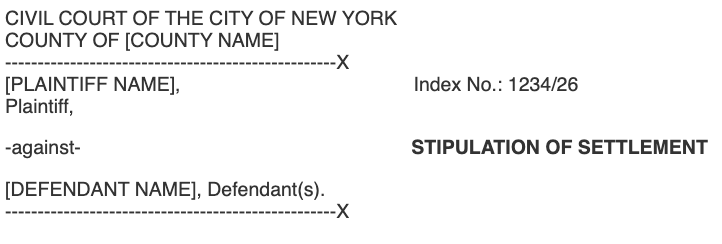
IT IS HEREBY STIPULATED AND AGREED, by and between the attorneys for the Plaintiff and the Defendant, that the above-captioned action is settled upon the following terms and conditions:
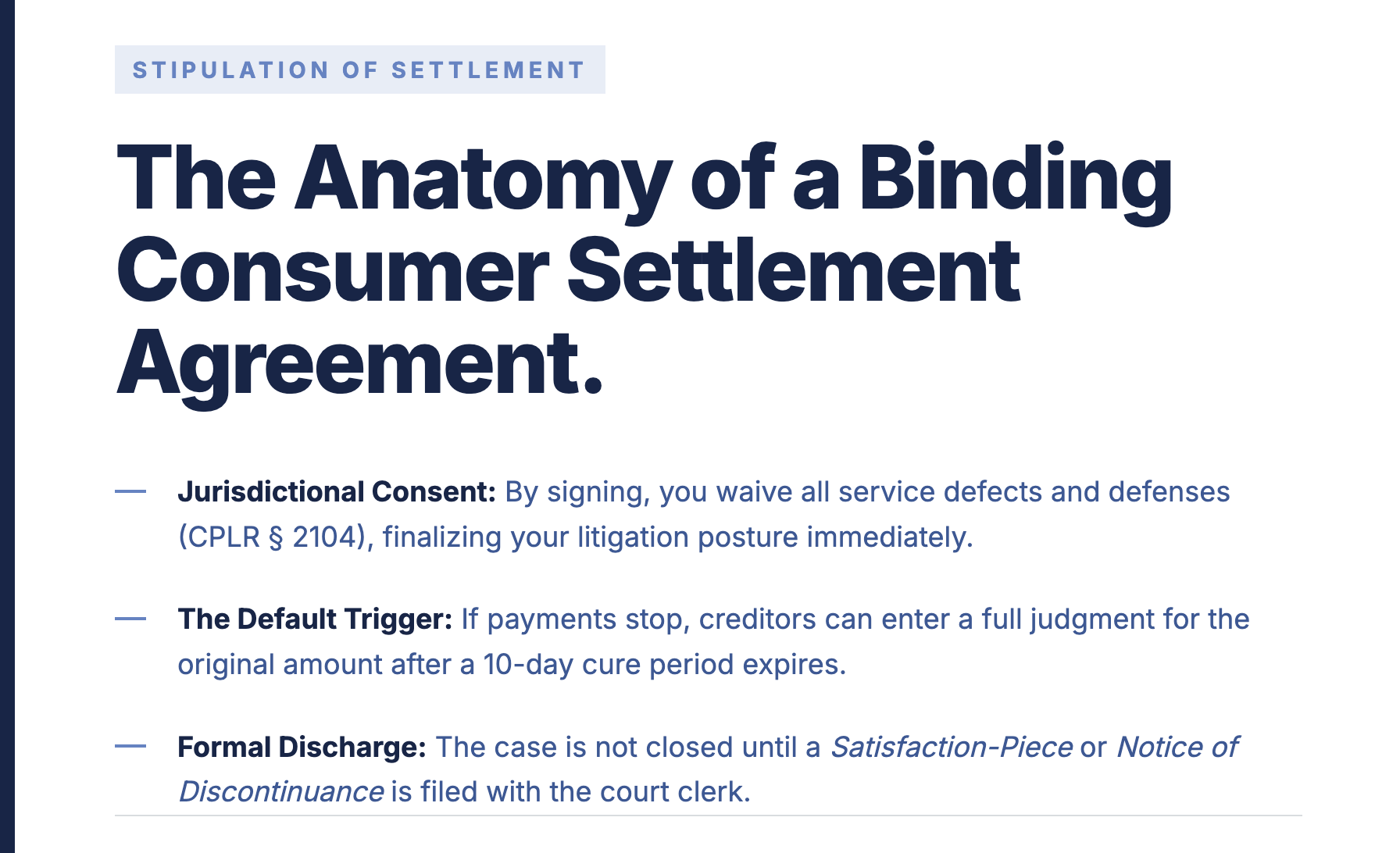
Defendant appears herein, admits and/or acknowledges service of the Summons and Complaint, waives and/or discontinues all defenses and/or counterclaims with prejudice, and consents to the jurisdiction of this Court.
Defendant agrees to pay Plaintiff the settlement sum of $[Amount] in full and complete settlement of this case as follows: (a) $[Amount] due on or before [Date], followed by continuing monthly payments of $[Amount] due on or before the [Date] of each consecutive month until the balance is paid in full.
All payments shall be made payable to [Plaintiff's Attorney/Firm] and mailed to [Address].
In the event of default in payment, notice of such default will be mailed by ordinary mail to the Defendant's attorney at their last known address. If such default remains uncured for ten (10) days, then the Plaintiff may enter a judgment without further notice for the relief demanded in the complaint, together with costs and disbursements, crediting the Defendant for any payments made hereunder.
Upon full payment of the settlement sum, a stipulation of discontinuance [or Satisfaction of Judgment] of this action shall be filed with the Court.
This stipulation may be signed in counterparts, and a facsimile, e-mail, or any other copy created by electronic transmission of this stipulation shall be deemed as an original.
Dated: ____________
Paragraph 1: Jurisdictional Consent and Waiver
(Establishes the court's authority and finalizes the litigation posture)
Consent to Jurisdiction: You generally waive objections to personal jurisdiction, including service defects under CPLR § 3211(a)(8), absent narrow grounds to vacate the stipulation such as fraud, mistake, or lack of authority.
Admission of Service: By acknowledging receipt of the summons and complaint, you effectively waive any claim of improper service (including "sewer service").
Waiver "With Prejudice": You waive all defenses in this action, including the statute of limitations and standing, unless they are expressly preserved in the stipulation. Note that while you waive defenses to the debt, you may still assert defenses to the enforcement of the stipulation itself (such as payment or improper entry of judgment).
Paragraph 4: Default and Acceleration
(Defines the financial penalties and procedural timelines for missed payments)
The Acceleration Mechanism: If the stipulation includes an acceleration clause, a default may allow the plaintiff to seek entry of judgment for the full amount demanded in the complaint, less any payments made. The availability of this "reversion" to the original debt depends entirely on the specific contract language.
The Cure Period: The cure period is calculated based on the notice provision in the stipulation. This clock may run from the date of mailing, the date of receipt, or another defined event. Because courts strictly enforce these timelines, verifying the "trigger" event is vital.
Proof Required for Judgment: Under CPLR § 3215(f), if a creditor seeks to enter judgment after a default, they must generally provide proof of the facts constituting the claim, the default, and the amount due. A well-drafted stipulation often streamlines this process for the creditor.
Paragraph 5: Finality and Discharge
(Outlines the formal mechanisms required to close the court record)
Discontinuance (Pre-Judgment): The stipulation typically requires the plaintiff to file a Notice of Discontinuance with prejudice pursuant to CPLR Rule 3217. This serves as a formal "merits" adjudication, preventing the claim from being refiled.
Satisfaction (Post-Judgment): If a judgment is already on file, the creditor is obligated under CPLR § 5020 to file a satisfaction-piece. Until a satisfaction is filed and recorded with the appropriate clerk, the judgment may continue to appear as an enforceable lien on real property.
Learn about the Benefits of Settling Early.
Special Section: Business Debt and Personal Guaranties
(Addresses risks unique to corporate officers and the assumption of individual liability)
Signatory Capacity: To impose personal liability, the agreement must clearly express the individual’s intent to be bound in a personal capacity. While often reflected by "signing twice," courts look for clear language indicating the officer is acting as a guarantor (Salzman Sign Co. v. Beck).
Enforceability: Courts generally will not consider prior oral statements that contradict a clear written agreement (McCoy v. Feinman), subject to limited exceptions such as fraud or ambiguity.
Asset Exposure: If an individual is bound and a default occurs, the creditor may enforce the resulting judgment against personal assets through post-judgment procedures under CPLR Article 52, including bank restraints and wage garnishments.
Legal Authority and Case Citations
Signatory Capacity and Personal Liability
Savoy Record Co. v. Cardinal Export Corp., 15 N.Y.2d 1 (1964) (Agent for disclosed principal not liable absent clear intent).
Salzman Sign Co. v. Beck, 10 N.Y.2d 63 (1961) (Establishing that clear intent is required to add personal liability to a corporate officer).
Bank of America, N.A. v. ASD Gem Realty LLC, 205 A.D.3d 1 (1st Dep't 2022) (Holding individual personally liable where the signature did not reflect agency or limitations).
Enforceability and The Parol Evidence Rule
McCoy v. Feinman, 99 N.Y.2d 295 (2002) (Stipulations strictly enforced according to their terms).
W.W.W. Associates, Inc. v. Giancontieri, 77 N.Y.2d 157 (1990) (Extrinsic evidence generally inadmissible to vary a clear written agreement).
Citibank, N.A. v. Plapinger, 66 N.Y.2d 90 (1985) ("Absolute and unconditional" language forecloses reliance on oral misrepresentations).
Vacating Stipulations and FAPA
CPLR § 5015(a): Provides potential grounds to vacate a default or a stipulation based on excusable default, newly discovered evidence, or fraud/misrepresentation.
Genovese v. Nationstar Mortg. LLC, 223 A.D.3d 37 (1st Dep't 2023) (Discussing FAPA and the finality of discontinuances under CPLR Rule 3217(e)).
Relevant Statutory Text
CPLR § 2104. Stipulations.
"An agreement between parties or their attorneys relating to any matter in an action... is not binding upon a party unless it is in a writing subscribed by him or his attorney or reduced to the form of an order and entered."
CPLR § 3215(f). Proof.
"On any application for judgment by default, the applicant shall file proof of service of the summons and the complaint... and proof of the facts constituting the claim, the default and the amount due by affidavit made by the party..."
CPLR Rule 3217. Voluntary discontinuance.
"(c) Effect of discontinuance. Unless otherwise stated... the discontinuance is without prejudice... (e) Effect of discontinuance upon certain instruments. ...the voluntary discontinuance... shall not, in form or effect, waive, postpone, cancel, toll, extend, revive or reset the limitations period..."
CPLR § 5020. Satisfaction-piece.
"(a) Generally. ...he shall execute and file with the proper clerk... a satisfaction-piece... acknowledged in the form required to entitle a deed to be recorded... A copy... shall be mailed to the judgment debtor... within ten days after the date of filing."
CPLR § 5201(b). Property against which a money judgment may be enforced.
"A money judgment may be enforced against any property which could be assigned or transferred... unless it is exempt from application to the satisfaction of the judgment."
Strategic Checklist Before Signing
Cure Period & Notice: Negotiate for 10+ days and ensure the clock starts upon receipt rather than mailing.
Attorney’s Fees: Watch for hidden clauses that shift the creditor's legal fees to you upon default.
Prejudice: Explicitly confirm the discontinuance is "with prejudice."
Grounds to Vacate: Remember that while stipulations are favored, CPLR 5015(a) remains a potential avenue if the agreement was reached through fraud or mistake.
New York Statutes (CPLR)
Educational analysis only. Not individualized legal advice.